
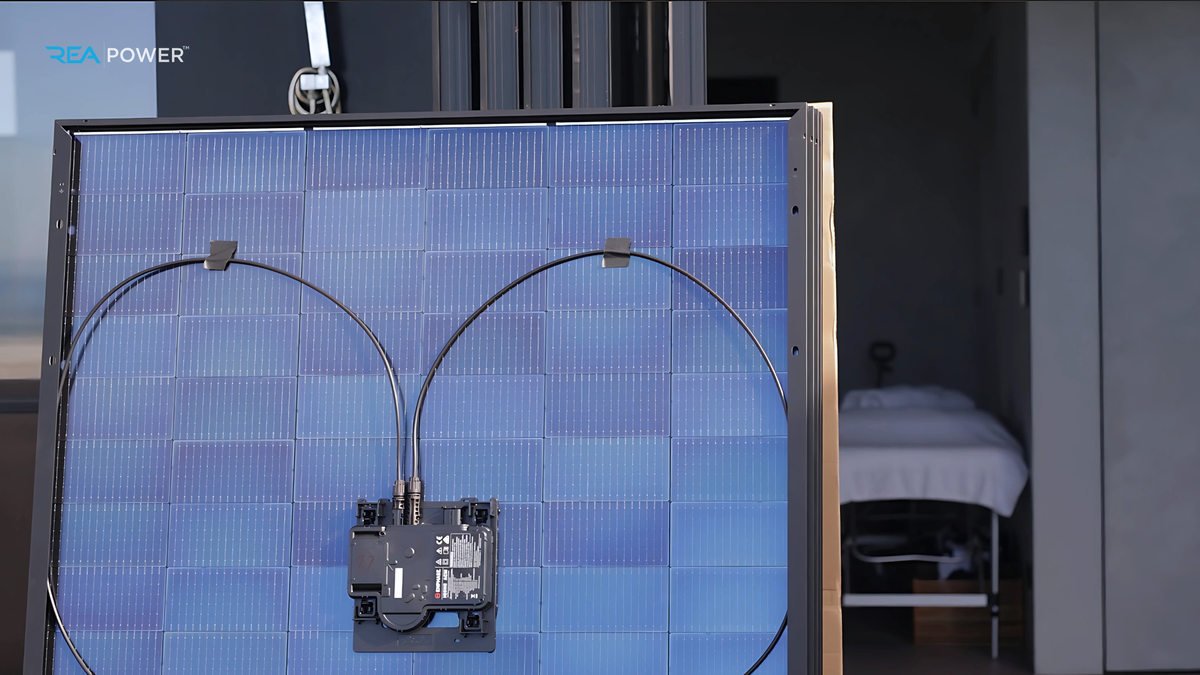
If you're comparing solar quotes and keep seeing "Enphase IQ8HC" listed against a panel spec, it's worth knowing exactly what that component does for you. The Enphase IQ8HC module is a microinverter — a small unit fitted to the back of a single solar panel that converts that panel's DC output to usable AC power right there on the roof, rather than sending raw DC down to one central string inverter. It's part of Enphase's IQ8 Series, built to pair with today's high-output 320–540 W panels, and it's the microinverter REA Power builds into its Type X AC module line for customers who want panel-level performance built in from day one.
The short version: instead of one inverter doing the work for an entire string of panels, each panel gets its own. That single design choice changes how a solar system behaves in shade, how it's monitored, how safe it is to work on, and how it performs over 25 years. Here's what that actually means in practice.
Panel-Level Power Optimisation, Explained
In a traditional string inverter setup, panels are wired together in series, and the whole string performs at the level of its weakest panel. One shaded panel, one panel facing slightly the wrong way, or one panel that's a few years older than the rest — and the entire string's output drops to match it.
Microinverters remove that constraint entirely. Because each Enphase IQ8HC module handles only the panel it's attached to, every panel produces at its own individual maximum, all the time. A system with panels facing east and west, split across two roof planes, or added to in a later expansion can all still perform at their own best, rather than being dragged down to the lowest common denominator. For homes with anything other than a single, uniform, unshaded roof — which is most homes — that's a genuine yield difference over the life of the system.
Resilience to Shading and Partial Underperformance
This is where the panel-level approach earns its keep, day to day. A tree branch, a chimney shadow, bird droppings, or a patch of dust on one panel won't drag down the panels around it. With the IQ8HC module, that one affected panel simply produces a little less for as long as it's affected — the rest of the array keeps working normally.
It matters over the longer term too. Panels degrade slightly at different rates, and a hail strike, micro-crack, or connector fault on one panel in a string system can quietly cost you output across every panel wired with it. Microinverters isolate that loss to the single panel involved — a meaningful difference if your roof has any shading at all from trees, neighbouring buildings, or roof features like vents and antennas.
Monitoring and Diagnostics: Per-Panel Visibility
Every Enphase IQ8HC module reports its own performance data back through the Enphase App, so you're never looking at one combined number for the whole system — you're seeing each panel individually. That means if panel fourteen starts producing 15% less than it should, you'll see it specifically, rather than noticing a vague dip in total output months later with no idea where to start looking.
For a homeowner, that turns troubleshooting from a guessing game into a two-minute check on your phone. For REA Power's installer network, it means faults can often be diagnosed remotely before a technician is even sent out — shortening repair times and keeping servicing costs down for the client.
Safety Benefits: Lower DC Voltage on the Roof
String inverter systems run high-voltage DC cabling across the roof and down to a central inverter — often several hundred volts. That's a real consideration for firefighters, tradespeople, and anyone doing roof work near the array, because DC current can't simply be switched off by cutting the mains the way AC can.
Because the Enphase IQ8HC module converts DC to AC at the panel itself, DC voltage on the roof is limited to what a single panel produces — nowhere near the multi-hundred-volt levels of a string system. It's also why microinverter systems meet rapid shutdown requirements without separate shutdown devices bolted on: cut the AC supply, and the DC side is inherently low-voltage across the whole array. Safer, simpler solar, by design.
How This Fits Into REA Power's Type X AC Module
REA Power builds the Enphase IQ8HC module into its Type X AC module line for exactly this reason — an AC module is a panel and microinverter factory-matched and shipped as one unit, removing a step of on-site assembly and reducing points of failure. Instead of an installer pairing a panel and microinverter on the roof, the two arrive already matched and tested. For installers, that means faster, more consistent installs. For the customer, it means one less variable that could go wrong at the connection point, and a system where panel-level performance, monitoring, and safety are built in rather than bolted on.
Why Trust REA Power for Your Solar and Battery System
REA Power designs and supplies solar panels, AC modules, and battery storage systems for both residential and commercial projects, working through an accredited installer partner network rather than a single local installation team. That structure matters for a few reasons. First, it means REA Power's products are specified and installed to a consistent standard by qualified installers, not by whoever happens to be free that week. Second, it means the company's reach isn't limited to one city or state — REA Power supports installer partners and customers across Australia, and the same standards extend to the UK and EU markets, giving the business a genuinely international footprint in solar manufacturing and supply, rather than a purely local one.
In Australia, that includes making sure installations go through Clean Energy Council (CEC) accredited installers — a requirement to remain eligible for federal solar rebates administered by the Clean Energy Regulator, and one that protects product warranties. REA Power's role is to make sure the hardware — panels, AC modules, batteries — is built to the standard those installers, and those rebate schemes, expect. For background on how solar and battery incentives currently work in Australia, the Australian Government's energy.gov.au is a reliable starting point.
If you're weighing up an Enphase IQ8HC-based system, or a broader solar and battery setup, for a home or a commercial site, REA Power's team can talk through what fits your roof, your usage and your budget — in Australia or overseas.
Call REA Power on 1300 360 047, or get in touch via reapower.com.au/pages/contact.
Frequently Asked Questions
What is an Enphase IQ8HC microinverter?
The Enphase IQ8HC module is a microinverter fitted to an individual solar panel that converts that panel's DC output to AC power on the roof, rather than relying on one central string inverter for the whole array. It's part of Enphase's IQ8 Series and is designed to pair with high-output 320–540 W panels.
What are the benefits of microinverters over a string inverter?
Microinverters let each panel perform at its own maximum regardless of shading, orientation or age differences elsewhere in the array. They also give per-panel monitoring, lower rooftop DC voltage for safety, and easier fault isolation and diagnosis than a string system, where one underperforming panel can drag down an entire string.
Does the Enphase IQ8HC improve solar panel safety?
Yes. Because DC-to-AC conversion happens at the panel rather than at a central inverter, DC voltage on the roof stays low, and the system inherently meets rapid shutdown requirements when the AC supply is switched off.
Can I monitor individual panel performance with Enphase microinverters?
Yes. Each Enphase IQ8HC module reports its own output through the Enphase App, so you can see how every individual panel is performing rather than one combined figure for the whole system.

Leave a comment
This site is protected by hCaptcha and the hCaptcha Privacy Policy and Terms of Service apply.