
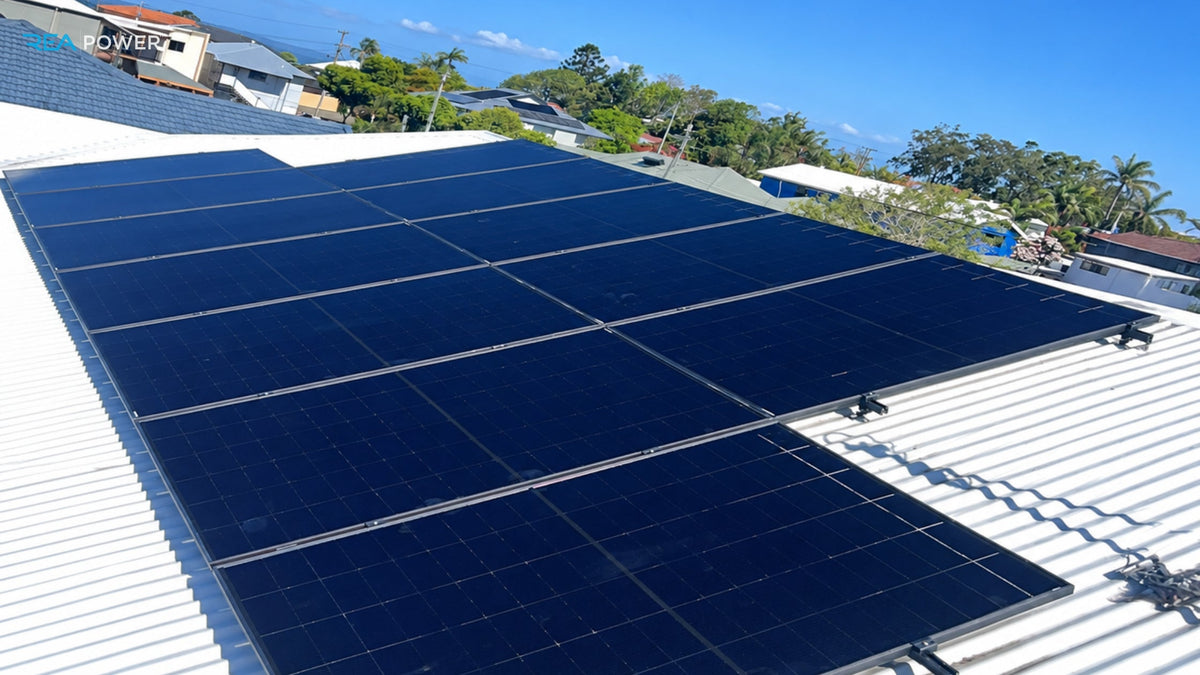
Yes. For rooftop safety, AC solar panels remove one of the best-known risks in a conventional solar system: high-voltage DC wiring running across your roof.
In a standard string system, panels are connected so their DC voltages add up—often to several hundred volts. An AC solar panel converts its power to AC at the panel using a microinverter. That removes the high-voltage DC string from the roof and allows each panel to be monitored individually.
REA Power's Type X AC module is built on this design. Here's how it works, why it's safer, and what it means for your home.
Key takeaways
- AC solar panels convert DC to AC at each panel, so there's no high-voltage DC string on the roof.
- DC at each panel stays below 60 V, compared with several hundred volts in a typical string system.
- Fewer high-voltage DC connections mean fewer places for the faults linked to many rooftop solar fires.
- Each panel works and reports independently, so a shaded or faulty panel is easier to identify.
- Safe solar still depends on quality products, an accredited installer and regular checks.
What is an AC solar panel?
An AC solar panel, also called an AC module, is a solar panel with its own microinverter attached. The microinverter converts the panel's DC electricity into AC electricity your home can use, right on the roof.
A conventional system works differently. Its panels are connected in a “string,” sending DC power across the roof and down to a central inverter, usually mounted on a wall.
|
Conventional string system |
AC solar panels |
|
|
Where DC becomes AC |
One central inverter on a wall |
At every panel |
|
DC voltage on the roof |
Panel voltages add up, often to several hundred volts |
DC voltage limited to each individual panel, with no high-voltage DC strings |
|
If one panel underperforms |
Can drag down the whole string |
Other panels keep producing at full capacity |
|
Monitoring |
Usually system or string level |
Every panel individually |
Why high-voltage DC on the roof is a fire risk
Many rooftop solar fires don't start in the panels. They start in the wiring, connectors and switches that link panels together, especially where those parts carry high-voltage DC.
There are three main reasons:
- DC arcs can keep burning. Household AC power switches direction 100 times a second, passing through zero each time, which helps a spark go out. DC doesn’t pass through zero, so a spark at a loose or damaged high-voltage connection can continue as an electrical arc.
- Rooftop DC isolators can fail. Many string systems have a DC switch on the roof. If water gets in, the contacts can corrode and overheat. Energy Safe Victoria investigated 53 rooftop solar fires in the 2022–23 financial year, and its audits found that moisture affecting DC isolators was a major cause of solar PV system fires.
- Every connection is a potential weak point. Loose, poorly crimped or mismatched connectors can overheat, and hail, rodents or roof work can damage cable insulation.
How REA Power's Type X AC module makes rooftop solar safer
Type X is REA Power's newest and highest-output solar panel, launched in 2026 and engineered in Australia. In its AC module form, every Type X panel converts its own power to AC on the roof.
Because each Type X panel converts its own power, DC never adds up across the array. The only DC is the short connection between each panel and its microinverter, which stays below 60 V. Everything leaving the panels is AC, the same type of electricity your home already uses.
REA Power offers two microinverter options:
- Enphase IQ8HC: a microinverter built into every panel, with integrated rapid shutdown.
- ATMOCE MI-1000: one microinverter serves two panels, with independent power tracking for each. It uses an extra-low-voltage design (below 60 V DC) with no high-voltage DC on the roof.
What happens if one panel is shaded or develops a fault?
The other panels keep producing. Each panel works independently, and panel-level monitoring shows the output of each one. If a panel underperforms, it’s easier to identify the issue than with a system-wide reading alone.
Type X also includes design features aimed at durability and performance:
- Lower hot-spot temperatures: Cells can overheat when part of a panel is shaded. In REA’s partial-shading test, Type X recorded 75 °C, compared with 104 °C for a conventional panel.
- Back-contact cells: All electrical contacts sit on the back of each cell, reducing stress points and the risk of microcracks.
- Dual-glass construction: Glass on both sides helps protect the cells from moisture, heat and mechanical stress.
- Designed for Australian weather: The panel was tested against 25 mm hail and is rated to operate from −40 °C to +85 °C.
For full specifications and warranty details, see REA Power’s Type X guide.
Do AC solar panels make a system risk-free?
No solar system is risk-free. AC solar panels remove high-voltage DC from the roof, but the system still needs to be installed and maintained correctly.
Your system still needs:
- An accredited installer. AC cabling, connectors and roof penetrations must be installed correctly.
- Suitable protection and isolation. Your installer will fit the protection and isolation devices your system design requires.
- Regular professional checks. Arrange periodic inspections, especially if your system is in a hot, coastal or dusty location.
- Clear labelling. Panels generate power whenever light reaches them, so firefighters need to know there’s solar on the roof.
If you notice a burning smell, discoloured equipment, damaged cables or repeated faults, contact your installer or a licensed electrician. In a fire, call Triple Zero (000) and tell the operator there are solar panels on the roof.
Is your solar a fire risk? Hear from a firefighter-electrician and our CEO
Mike Goldman, whose home was damaged in a solar fire, talks to our CEO, Michael Mrowka, and firefighter-electrician Michael Ware about rooftop fire risk, AC vs DC solar, and what to ask before you buy.
Frequently asked questions
Are AC solar panels safer than regular solar panels?
AC solar panels remove high-voltage DC string wiring from the roof, which is associated with rooftop solar faults such as DC arcing and isolator failures. Like any solar system, they still need correct installation and regular maintenance.
What is the difference between AC and DC solar panels?
A DC solar panel sends DC power to a central inverter, usually through a high-voltage string. An AC solar panel has a microinverter that converts its power to AC at the panel, so high-voltage DC doesn’t run across the roof.
Do AC solar panels need a rooftop DC isolator?
AC solar panels don’t have a high-voltage DC string of the kind rooftop DC isolators were designed to switch off. Isolation requirements still depend on the system design and Australian standards, so ask your installer what your system needs.
Can AC solar panels still catch fire?
Any electrical equipment can fail. AC solar panels reduce rooftop fire risk by removing high-voltage DC, but correct installation, quality components and periodic inspections still matter.
What happens if one AC solar panel fails?
The rest of the system keeps working. Each panel operates independently, and panel-level monitoring helps show which panel needs attention.
What is Type X?
Type X is REA Power’s latest solar panel, launched in 2026. It uses back-contact cells and dual-glass construction and is available as an AC module with a built-in microinverter. See REA Power’s Type X guide for specifications and warranty details.
Do AC solar panels work with batteries?
Yes. AC solar panels can be paired with home battery storage. Read our Are Home Batteries Safe? guide to learn more about battery safety.
Ready for safer solar?
Talk to REA Power about Type X AC modules for your home or business. Call 1300 360 047 or contact us to connect with an authorised Power Partner for an energy analysis and quote.
Installers and energy professionals: join our Power Partners network to bring REA Power AC solar technology to your customers.

Zostaw komentarz
Ta strona jest chroniona przez hCaptcha i obowiązują na niej Polityka prywatności i Warunki korzystania z usługi serwisu hCaptcha.