
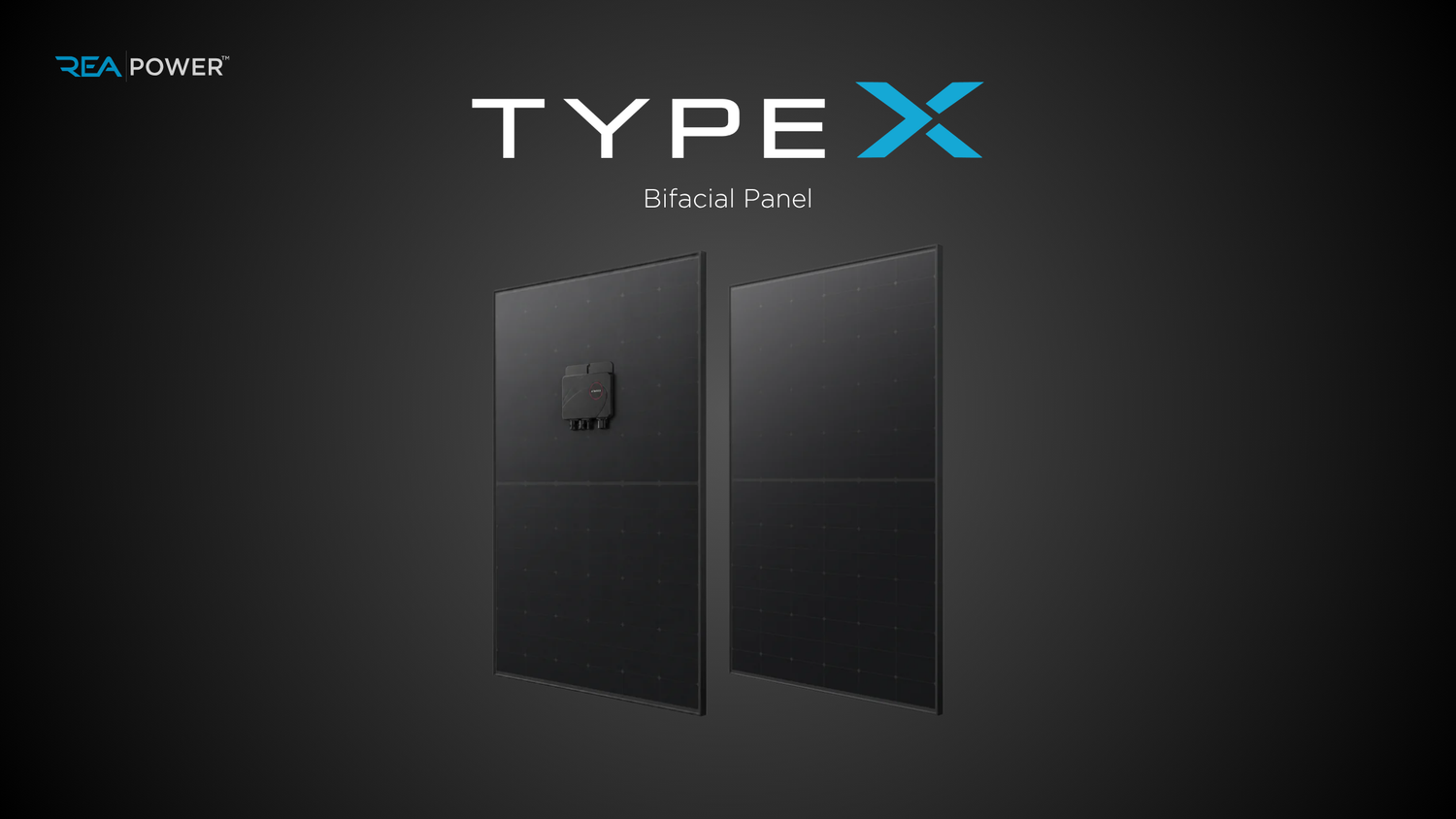
Quick Answer: Bifacial solar panels generate power from both sides — front and rear — capturing direct, reflected, and diffused sunlight all at once. Installed in the right conditions, they can typically produce 5–20% more energy than a comparable monofacial panel. They really come into their own on ground-mounted systems, solar carports, and some commercial rooftops, where more reflected light reaches the rear of the panel.
As solar technology keeps advancing, efficiency remains the biggest priority for homeowners, businesses, and developers alike. Bifacial solar panels are one of the clearest examples — designed to generate more electricity simply by putting both sides of the panel to work.
Where a traditional panel only ever sees the sun from the front, bifacial technology captures reflected and diffused light too — light that would otherwise go to waste. More energy, same roof or ground footprint.
In this guide: how bifacial panels work, how they stack up against monofacial panels, the conditions that get the best out of them, and how REA Power's Type X technology helps push performance further.
What Are Bifacial Solar Panels?
Bifacial solar panels are photovoltaic (PV) modules built to generate power from both the front and rear of the panel — power from both sides, as the name suggests.
The front does what every panel does: captures direct sunlight. The transparent rear goes further, converting sunlight reflected off the ground and nearby surfaces into extra electricity. Put that extra capture to work, and bifacial modules can lift overall system output under the right conditions.
Most modern bifacial panels use dual-glass construction — swapping the usual opaque backsheet for a second layer of tempered glass. That lets more light reach the rear cells while also boosting durability, weather resistance, and long-term performance.
How Do Bifacial Solar Panels Produce More Energy?
The advantage is simple: bifacial panels capture the light everyone else leaves on the table.
Sunlight hits the ground, bounces back up, and where a monofacial panel would let that light go to waste, a bifacial panel's rear side turns it into extra electricity — power from both sides.
A few key factors decide just how much extra you'll get.
Ground Reflectivity (Albedo)
How much sunlight bounces back depends heavily on what's underneath the panels — known as ground albedo.
Highly reflective surfaces include:
- White gravel
- Concrete
- Light-coloured roofing materials
- Reflective roof membranes
- Snow
Darker surfaces like asphalt, grass, or soil soak up more light and generally deliver smaller bifacial gains.
Mounting Height
The gap between panel and surface matters too. The higher the panel sits, the more reflected light reaches the rear cells — which is exactly why ground-mounted systems, solar carports, and raised rooftop installs get the most out of bifacial technology.
System Design
Tilt, spacing, shading, orientation, and local conditions all play a part. A well-designed system is what actually unlocks the full potential of bifacial panels on a given site.
Bifacial vs Monofacial Solar Panels
Understanding bifacial vs monofacial technology helps determine which solution is best suited to your project.
|
Feature |
Monofacial Solar Panels |
Bifacial Solar Panels |
|
Energy generation |
Front side only |
Front and rear sides |
|
Rear-side electricity generation |
No |
Yes |
|
Construction |
Glass with backsheet |
Dual-glass design |
|
Best suited for |
Most residential rooftops |
Rooftops, carports, commercial buildings and ground-mounted systems |
|
Energy potential |
Standard |
Higher under suitable conditions |
Monofacial panels are still an excellent choice for plenty of residential systems. But where conditions allow effective rear-side light capture, bifacial panels generate extra electricity without adding a single extra module — genuinely more power from the same space.
How Much More Energy Can Bifacial Solar Panels Produce?
There's no single number that fits every roof — it depends on the system design and what's around it.
In most applications, bifacial panels generate roughly 5–20% more electricity than a comparable monofacial panel. The biggest gains show up on elevated or ground-mounted systems over highly reflective surfaces, while standard pitched residential roofs usually see more modest lifts. Get the reflectivity and mounting height right, and the gains climb further still.
Rather than chasing one fixed percentage, it's more useful to think about what drives the number: ground reflectivity, mounting height, system layout, and local climate all shape how much extra energy bifacial technology delivers over the system's lifetime.
Best Installation Conditions for Bifacial Solar Panels
Bifacial panels work in plenty of settings, but some give them far more to work with than others.
The best conditions for maximising energy output include:
|
Installation Type |
Performance Potential |
|
Ground-mounted solar systems |
Excellent |
|
Solar carports |
Excellent |
|
Commercial flat roofs with reflective membranes |
High |
|
Elevated rooftop systems |
Moderate to High |
|
Standard pitched residential roofs |
Moderate |
Ground-mounted arrays and solar carports tend to see the biggest gains, thanks to the extra elevation letting more reflected light reach the rear cells. Commercial buildings with light-coloured roofing or reflective membranes can benefit too.
Standard residential rooftops still get a lift from bifacial technology — just a more modest one, since the panels sit closer to the roof surface. Roof design, mounting system, surrounding surfaces, and local conditions all shape the actual result.
How REA Power's Type X Technology Supports Higher Performance
High-performing solar panels need more than bifacial glass alone. REA Power's Type X solar modules pair Native Bifacial Design with N-Type cells and FusionCell™ Architecture to lift efficiency, durability, and long-term output all at once.
The dual-glass build lets the rear of the module capture reflected sunlight while protecting the cells from the elements. Paired with advanced cell architecture, Type X modules are engineered to cut electrical losses and deliver dependable performance across residential, commercial, and utility-scale projects.
Want a simpler install without giving up bifacial gains? REA Power's Bifacial AC Solar Module pairs an integrated microinverter with bifacial energy generation in one panel.
Are Bifacial Solar Panels Worth It?
For most projects, yes — though how much you get out of them depends on how and where the system goes in.
Residential Systems
Homeowners benefit most where elevated mounts, flat roofs, pergolas, or light-coloured roofing let more reflected light reach the rear of the panel. On a standard pitched roof, the extra gain is usually smaller — still worthwhile, just more modest.
Commercial and Utility-Scale Projects
Commercial buildings and large-scale developments are often the ideal setting for bifacial technology. Flat roofs, carports, and ground-mounted systems typically capture far more rear-side light, boosting output and long-term returns.
Why Choose REA Power?
Choosing a solar manufacturer means looking past panel efficiency alone. Quality engineering, product reliability, and continuous innovation are what actually drive long-term performance.
REA Power builds advanced solar technology for residential, commercial, and utility-scale projects across Australia, the UK, Europe, and beyond — including high-performance modules built on N-Type cell architecture, Fusion Reverse Contact (FRC) technology, dual-glass bifacial design, and integrated AC solar solutions.
Engineered for long-term reliability and backed by industry-leading warranties, REA Power's technology is built to deliver dependable energy — wherever it's installed.
Key Takeaways
Bifacial solar panels are one of the most effective ways to squeeze more solar energy out of the same footprint, generating power from both sides of the module rather than just one.
How much extra you get depends on ground reflectivity, mounting height, and system design — but where conditions allow, bifacial technology can meaningfully lift the long-term performance and value of a residential, commercial, or utility-scale system.
Exploring advanced solar solutions? REA Power builds technology designed to maximise efficiency, durability, and long-term performance.
Ready to learn more? Contact REA Power on 1300 360 047 or visit the REA Power contact page to talk through the right solar and battery solution for your project.
Frequently Asked Questions
How much extra energy do bifacial solar panels produce?
Bifacial solar panels typically generate 5% to 20% more electricity under suitable installation conditions. Standard pitched residential roofs usually achieve smaller gains than elevated or ground-mounted systems, as performance depends on installation height, ground reflectivity, panel spacing, and overall system design.
Do bifacial panels work on a normal roof installation?
Yes. Bifacial panels can be installed on standard residential roofs, although the additional energy gain is usually smaller than in elevated or ground-mounted systems where more reflected sunlight reaches the rear of the module.
Are bifacial solar panels worth the additional investment?
They can be. Projects with favourable installation conditions often achieve higher lifetime energy production, improving the overall value of the solar system. A professional assessment can help determine whether bifacial technology is the right choice for your property.
What conditions are best for bifacial solar panels?
Bifacial solar panels perform best when installed above reflective surfaces with adequate clearance beneath the modules. Ground-mounted systems, solar carports, elevated rooftops, and commercial buildings with reflective roofing materials generally provide the greatest rear-side energy gains.

Leave a comment
This site is protected by hCaptcha and the hCaptcha Privacy Policy and Terms of Service apply.