
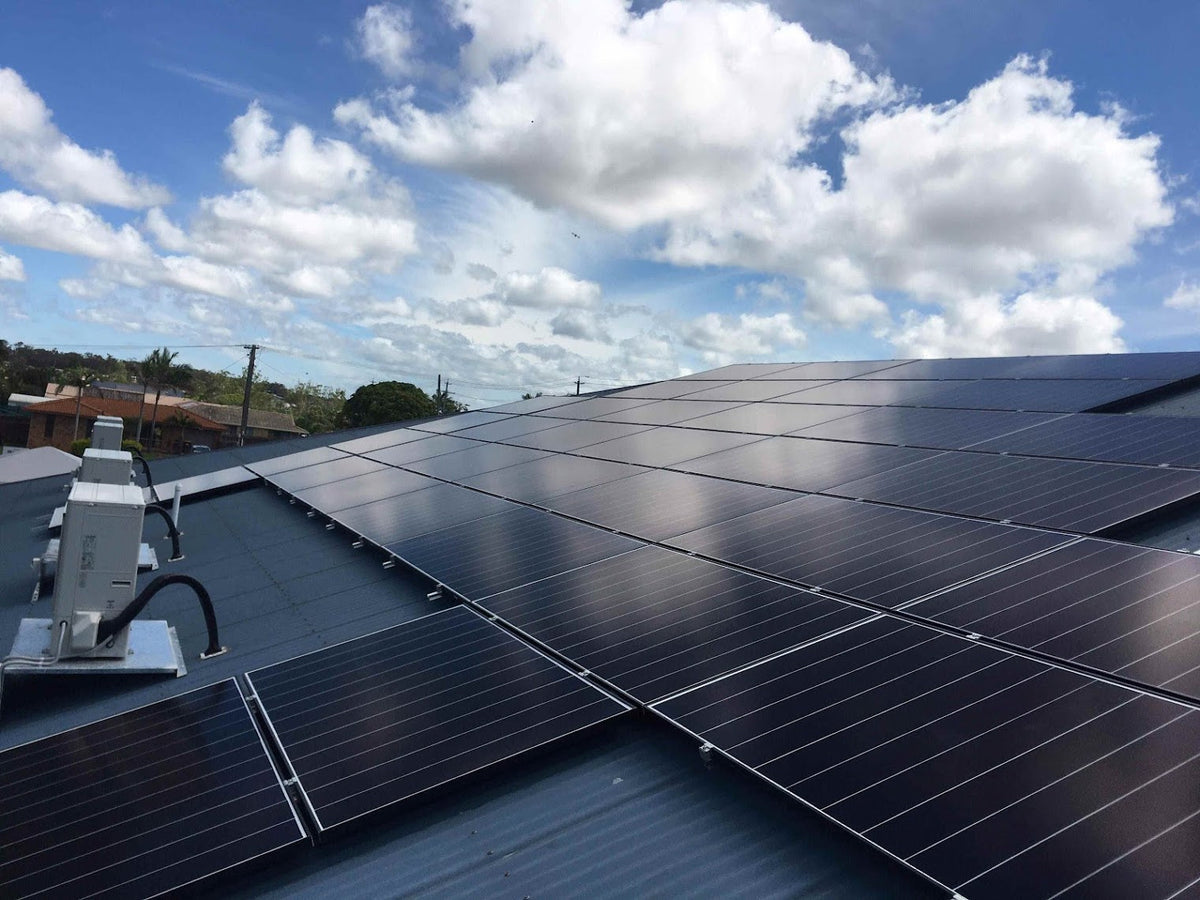
How efficient are solar panels, then? Most modern panels turn about 20 to 22 per cent of the sunlight that lands on them into electricity, and the best ones on the market reach 23 to 24 per cent. That number matters, but it isn't the whole story. What a system actually generates depends just as much on its size, which way the roof faces, shade and the weather.
What Is Solar Panel Efficiency?
Put simply, it's the share of the sunlight hitting a panel that ends up as electricity. Manufacturers measure it in a lab under standard test conditions: 1,000 watts of sunlight per square metre, with the cells at 25°C.
Efficiency (%) = panel power (W) ÷ (panel area (m²) × 1,000 W/m²) × 100
Take a 440 W panel that measures 1.95 m². That's 440 ÷ 1,950, or about 22.6 per cent. Your roof won't match lab conditions, so treat the rating as a way to compare panels, not a forecast of what you'll generate.
How Efficient Are Modern Solar Panels?
Most standard panels sit between 20 and 22 per cent. The most efficient solar panels you can buy today reach around 23 to 24 per cent. Those are market-wide ranges rather than promises about any one product, so check the datasheet for the exact model you're considering.
No panel gets anywhere near 100 per cent. A single-junction silicon cell tops out at around 29 per cent in theory, and commercial panels sit well below that.
What Makes Some Panels More Efficient?
- Cell Technology: n-type TOPCon, heterojunction and back-contact cells generally outperform older PERC designs.
- Panel Design: putting the electrical contacts on the back of the cell leaves more of the front open to light.
- Temperature: output typically drops by roughly 0.3 to 0.5 per cent for every degree above 25°C, so a lower temperature coefficient helps on hot days.
- Shading and Orientation: Energy Saving Trust says east- or west-facing systems tend to generate around 15 to 20 per cent less than south-facing ones, and shade from trees or chimneys cuts output further.
Solar Panel Performance in UK Weather
Panels run on daylight, not just direct sun. When it's cloudy, diffuse light still reaches the cells, so they keep generating. There's simply less of it to work with.
Winter is where the real dip happens. Days are short and the sun sits low, so total generation falls a lot. One UK supplier estimates that systems produce roughly 10 to 25 per cent of their yearly electricity between December and February. The cold isn't to blame, though. Cells actually work a little better when they're cool, so the winter drop comes down to light, not temperature.
Efficiency vs Solar Panel Output
Efficiency is how well a panel converts light. Output is the electricity you actually get, measured in kilowatt hours (kWh) over a period of time. Ten 400 W panels give you 4 kW of capacity; ten 440 W panels give you 4.4 kW. But if your roof has space for more panels, a cheaper, lower-rated option fitted in greater numbers can match or beat a smaller array.
More efficient solar panels earn their keep when roof space is tight. Energy Saving Trust puts the typical UK home system at about 4.5 kWp, using around 12 panels across 20 to 30 m². On a big commercial roof, cost per kilowatt and when the building uses its power often matter more than the last percentage point.
Choosing Solar Panels for Homes and Businesses
If you've got a small or awkward roof, look closely at efficiency and wattage per panel. Businesses usually have more space, so total installed capacity, cost per kW and how generation lines up with working hours tend to matter more. Either way, judge high performance solar panels on datasheet evidence and warranties, not headline claims.
REA Power manufactures solar modules designed for residential and commercial applications. Its bifacial, dual-glass panels can capture sunlight from both sides, while the range includes standard DC modules and AC modules with an integrated microinverter. The modules come with a 25-year product warranty and a 30-year performance warranty. When comparing options for a UK property, it's worth checking the specific model's efficiency rating, power output and warranty terms to make sure they suit the project.
Solar Panel Degradation and Long-Term Performance
Every panel loses a little output each year. A widely cited National Renewable Energy Laboratory review found a median of about 0.5 per cent a year for field-tested modules. On a straight-line basis, that leaves roughly 87 to 88 per cent of original output after 25 years. The product warranty covers faults, while the performance warranty guarantees a minimum output at set points, so it's worth reading both.
How to Compare Solar Panel Options
- What are the rated efficiency and wattage of the exact panel model?
- What is its temperature coefficient?
- What annual generation (kWh) is estimated for my roof's orientation and shading?
- What do the product and performance warranties cover, and who handles claims?
- Is the installer MCS-certified?
FAQs
How efficient are solar panels on cloudy days?
They still generate, just less. Cloud scatters sunlight rather than blocking it entirely, so panels keep working from diffuse daylight at a lower output. How much lower depends on how thick the cloud is, the time of year and how the system is installed.
Is a 100% efficient solar panel possible?
No. A single-junction silicon cell has a theoretical limit of around 29 per cent, and commercial panels typically reach 20 to 24 per cent. Researchers are working on tandem designs that aim higher, but no commercial panel turns all incoming sunlight into electricity.
How efficient are solar panels in winter?
They still work, but you'll get far less electricity than in summer. Short days, cloud and a low sun all cut total generation. Cold weather doesn't necessarily hurt efficiency and can even help, so the shortfall is mostly about light.
What is the difference between solar panel efficiency and solar panel output?
Efficiency is the proportion of sunlight a panel converts into electricity. Output is how much electricity you actually get over a given period. Output also depends on panel wattage, sunlight, roof conditions and the size of the system.
Do the most efficient solar panels always produce the most electricity?
Not always. Higher efficiency is useful when roof space is limited, but total generation also depends on panel wattage, how many panels you fit, shading, orientation and the installation as a whole.
Talk to REA Power About Solar Technology
If you'd like to know more about REA Power's solar technology or talk through what you need, call 1300 360 047 or use the contact page. If you need someone to install it, REA Power's UK Power Partners include HSEnergy and Cobolt Blue Energy. It's worth asking each of them directly which areas they cover.
Join the REA Power Partner Network
Work in solar installation or distribution and interested in supplying REA Power technology? Have a look at the partners page or get in touch using the details above.

Leave a comment
This site is protected by hCaptcha and the hCaptcha Privacy Policy and Terms of Service apply.