
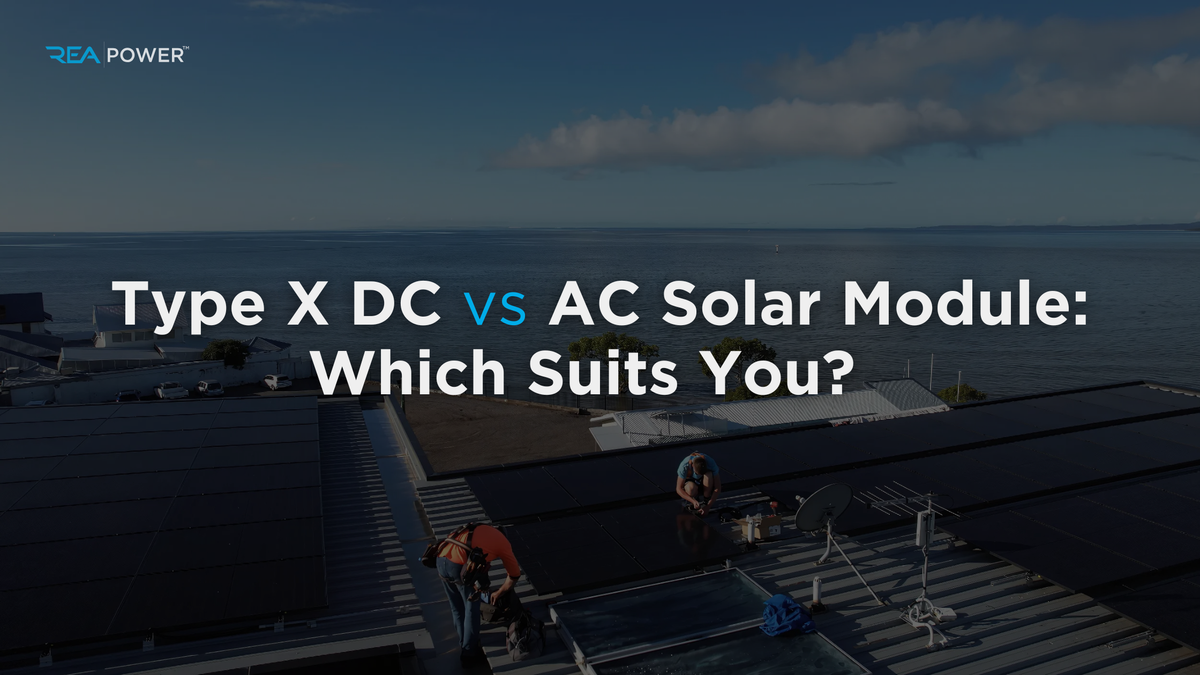
Choosing between a DC and an AC solar module isn't about picking the better technology — it's about picking the right setup for your roof, your budget, and how your system might grow down the track. Both the Type X DC module and the Type X AC module are built on the exact same cell, so the panel itself performs identically either way . What separates them is simply where the power conversion happens: centrally, through a string or central inverter, or individually, right at the back of each panel.
That one design choice shapes everything from install complexity to how well the system copes with shading — which is exactly why this comparison exists. Below, we've broken down the specs, the ideal use cases, and the practical trade-offs, so you can work out which module fits your project, whether that's a suburban rooftop or a large commercial array.
Same Cell, Different Power Path
Both modules are built on the Type X Cell Dual Glass platform, engineered with N-Type and 0BB architecture paired with FRC (Fusion Reverse Contact) technology. This is what pushes module efficiency up to 24.5%, keeps annual degradation to a low 0.35%, and backs both modules with a 25-year product warranty alongside a 30-year linear performance warranty. Dual-glass construction and bifacial design come standard on both, so either version can capture reflected light from the rear of the panel for extra yield — and both are built to hold onto the vast majority of their output, around 88.85%, after three decades in the field.
The difference is entirely in the power electronics. The DC module sends raw direct current to a central or string inverter elsewhere in the system, which then converts it to usable AC power for the home or business. The AC module skips that step at the array level entirely — each panel has a built-in Enphase IQ8HC microinverter, so conversion happens panel by panel, right on the roof.
Side-by-Side Comparison
|
Feature |
Type X DC Module |
Type X AC Module |
|
Power output |
475W–500W |
475W–500W |
|
Efficiency |
Up to 24.5% |
Up to 24.5% |
|
Cell technology |
Type X FRC, N-Type, 0BB |
Type X FRC, N-Type, 0BB |
|
Construction |
Dual-glass, bifacial |
Dual-glass, bifacial |
|
Product warranty |
25 years |
25 years |
|
Performance warranty |
30 years linear |
30 years linear |
|
Annual degradation |
0.35% |
0.35% |
|
Power conversion |
Central/string inverter |
Built-in Enphase IQ8HC microinverter per panel |
|
Monitoring |
System-level (typically) |
Panel-level |
|
Shading tolerance |
Whole-string impact |
Isolated to affected panel |
As the table shows, the only meaningful variable is the inverter setup — everything else about the panel's power, durability, and warranty coverage is identical.
When the DC Module Makes More Sense
A DC module paired with a central or string inverter tends to be the more cost-effective route for larger systems, particularly commercial and utility-scale installations where dozens or hundreds of panels are running in clean, unshaded conditions. Fewer individual components on the roof means a simpler bill of materials, and string inverters are generally cheaper per watt than an equivalent number of microinverters. For cost-sensitive projects with a straightforward roof layout — one orientation, minimal obstructions — the DC configuration is usually the smarter economical choice, without giving up any panel-level performance.
When the AC Module Makes More Sense
The AC module earns its place on roofs that aren't so simple. If part of the array is shaded by a chimney, tree, or neighbouring structure for part of the day, a string inverter setup means the whole string's output can drop to match the weakest panel. Because the Enphase IQ8HC microinverter operates independently on each AC module, shading on one panel doesn't drag down the others — the rest of the array just keeps producing. That same independence gives you panel-level monitoring, so spotting an underperforming panel is a quick check rather than a process of elimination across a whole string.
The AC module also suits homes or businesses planning to expand their system later. Adding panels to a microinverter-based array is generally simpler, since each new panel operates as its own unit rather than needing to be matched to an existing string's electrical characteristics. For complex roof geometries — multiple faces, varying pitch, partial shade — the AC module is usually the more practical option, even if the upfront cost per watt is a little higher.
Pricing and Installation Considerations
Expect the AC module to carry a higher upfront cost due to the integrated microinverter hardware — but that's often offset by lower design complexity and, in some cases, reduced electrical works during installation, since there's no separate string inverter to size, position, and wire. The DC module setup keeps panel costs lower but shifts more of the system cost and complexity into the central inverter, which needs to be sized correctly for the array and may need replacing before the panels themselves reach end of life. A licensed installer can run the numbers for your specific site, factoring in roof shape, shading, and your local electrical requirements — the Clean Energy Council maintains a list of accredited installers across Australia if you're comparing quotes.
Recommendation Framework by Property Type
For a single-storey home with a clear north-facing roof and no shading issues, the DC module is typically the simpler, more affordable option. For a home with a complex roofline, partial shading from trees or neighbouring buildings, or plans to add panels down the track, the AC module's panel-level independence is well worth the extra spend. For commercial and large-scale installations prioritising cost per watt across a large, unshaded array, the DC module generally wins on economics. And for anyone wanting granular, panel-by-panel performance data — genuinely useful for maintenance planning on larger commercial sites too — the AC module's built-in monitoring is a real advantage.
Government guidance from the Clean Energy Regulator and the Department of Climate Change, Energy, the Environment and Water is worth reviewing if you're also weighing up rebates and Small-scale Technology Certificates, as eligibility and system requirements can shape which configuration makes the most financial sense.
Why Trust REA Power
REA Power manufactures and supplies solar panels and battery systems through an established partner network across Australia, the UK, and the EU — so whichever module suits your project, you're backed by a manufacturer with a track record across multiple markets, not just a single local installer. Every Type X module, DC or AC, comes with the same 25-year product warranty and 30-year linear performance warranty, and REA Power works with accredited installers to make sure the configuration you choose is fitted correctly for your site and local grid requirements.
Because energy independence shouldn't be a compromise — only the best will do.
If you're still weighing up which module fits your property, call REA Power on 1300 360 047 or get in touch via the contact page to talk through your options with the team.
FAQs
What's the difference between the Type X DC module and Type X AC module?
Both use the same Type X cell, but the DC module relies on a central or string inverter while the AC module has a built-in Enphase IQ8HC microinverter on every panel.
Is the Type X AC module more efficient than the DC module?
No — both modules share identical cell efficiency of up to 24.5%. The AC version's advantage is in shading tolerance and monitoring, not raw efficiency.
Which Type X module is better for a home with partial roof shading?
The AC module, since each panel's microinverter operates independently and shading on one panel won't reduce output from the rest of the array.
Does the Type X AC module cost more to install?
The panel hardware typically costs more upfront due to the built-in microinverter, though this can be partly offset by simpler system design and reduced central inverter costs.

Zostaw komentarz
Ta strona jest chroniona przez hCaptcha i obowiązują na niej Polityka prywatności i Warunki korzystania z usługi serwisu hCaptcha.